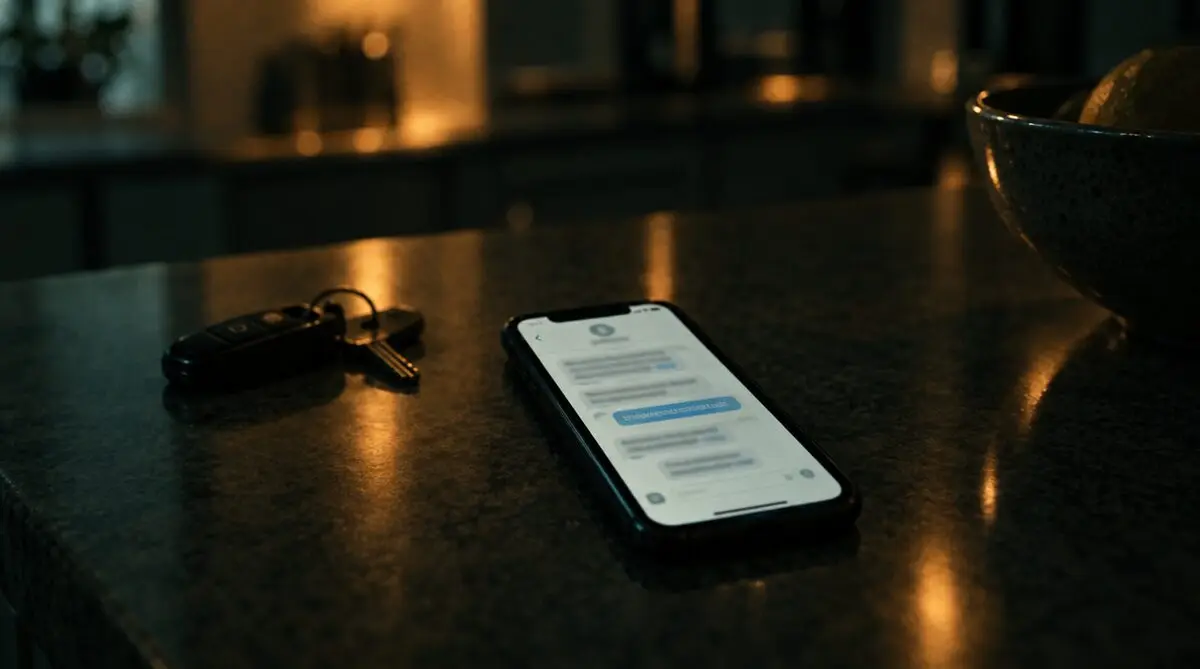
A text sits on your phone in the same thread as the genuine messages from your parcel service or your bank. The sender name looks right, the text threatens a return or an account block, and a link is meant to fix the problem. This article shows why the sender name proves nothing, how to have text and link checked, and what matters after a click or a card approval. If the text arrived after an order in an online shop, the article Parcel and customs texts from our sister service fakeshop.ai explains the customs rules.
Why the sender name proves nothing
With text messages, a name can be set in place of the phone number. In a consumer notice from January 2022, the Banco de España describes how fraudsters replace the number with text that poses as the bank. The fake message then appears in the same conversation thread as the bank’s genuine messages, so the recipient suspects nothing. Fakes in the name of parcel services, public bodies or mobile providers use the same principle.
Spelling helps only to a limited degree. The German Federal Office for Information Security (BSI) writes that criminals deliberately use typos, spelling mistakes or random character strings to get past spam filters. A text without mistakes is therefore no reassurance. The police advise never tapping links in unsolicited messages and, if in doubt, contacting your bank on its official phone number.
Have the message and link checked
On the page Check a message you paste the text of a text or messenger message, or upload a screenshot. onlinebetrug.ai has the wording, any links and other features of the message checked, without you having to open the link yourself. An unremarkable result is no guarantee. It only means that nothing stood out in this message at the time of the check. New fakes can slip through, above all in the first hours of a wave. So even after an unremarkable result, do not tap the link before you have opened the service yourself.
The proven rule also applies: open the service yourself, through its app or the address from your order or contract. There you can see whether a shipment or a message exists. Verbraucherzentrale Niedersachsen points out that parcel services do not ask you to pay for goods in advance. If the message contains a phone number you are unsure about, check it under Check a phone number. Similar fakes by email are covered in the guide Spotting and reporting phishing emails.
Reporting a text to the Bundesnetzagentur
The Federal Network Agency (Bundesnetzagentur) offers separate complaint forms, among others for unsolicited texts and messenger messages and for manipulated phone numbers in calls. According to its own information, it can issue warnings for violations, have phone numbers disconnected and prohibit billing or debt collection. A fine against text spam is not provided for by law.
The agency’s statistics show how much rests on reports. For 2025 it gives 85,158 complaints about number misuse in total and about 6,200 disconnected numbers (release of 9 February 2026). According to the agency, most complaints concerned text and messenger spam as well as nuisance calls. A single report will not get you a refund. It does help to record numbers and patterns.
If you suffered a loss, the case also belongs with the police. The consumer advice centre recommends filing a report online with your state’s police, including screenshots of the message, and noting the case number for your bank. Online stations and other offices are listed under Where to report it.
Already clicked, already paid?
What to do depends on what happened. After a click on the link, the BSI recommends flight mode, a call to your mobile provider, a look at your accounts, a police report and then a reset of the device after backing up your data. Verbraucherzentrale Niedersachsen adds that on Android nothing has happened as long as you have not tapped the link.
What happened?
Only saw the text
- Do not tap it
- Have it checked
- Report to the Bundesnetzagentur
- Delete it
Opened the link or installed an app
- Switch on flight mode
- Call your mobile provider
- Check accounts for unknown debits
- File a report, reset the device only afterwards
Entered card details or approved a payment
- Block the card now: 116 116
- Tell the bank, dispute unknown debits in writing
- Claims lapse after 13 months at the latest
- File a report with screenshots
Steps based on the BSI, the consumer advice centre and the law, as of 10 Oct 2026.
Sources: BSI: Smishing; Blocking hotline 116 116; Section 676b BGB
If you entered card details
- Block the card.
The blocking hotline 116 116 is available every day around the clock, from abroad on +49 116 116 or +49 30 4050 4050. Among other things it blocks credit and debit cards as well as online banking access.
- Inform the bank.
List the debits you did not make and demand the refund in writing. For credit cards the bank can also start a chargeback, which according to the consumer advice centre may involve fees. More under Already paid?.
- Secure evidence.
Screenshots of the text, the link and the page, account statements and the case number of your report. How to do this is under Already paid?.
On deadlines: under Section 675u of the German Civil Code (BGB), the bank must refund an unauthorised payment without delay, at the latest by the end of the business day after your report. The exception is a justified suspicion of fraudulent conduct by the customer, which the bank has notified to the competent authorities. Under Section 676b you must inform the bank without delay after noticing the payment. After 13 months your claims lapse.
It gets harder if you approved a payment yourself in your banking app. Under Section 675v you are liable for the entire loss if you acted with gross negligence. The consumer advice centre observes that banks often turn fraud victims away without proving gross negligence, and points out that the bank must set out the authentication and its evidence. Have a refusal reviewed, for example by a consumer advice centre, before you give up.
Everyday protection
- Third-party billing block. Set it up with your mobile provider. It prevents third parties from charging amounts to your phone bill.
- Apps from stores only. On Android, switch off installation from unknown sources.
- Spam filter. Turn on your phone’s filter if it has one.
- Do not reply. A reply tells fraudsters that the number is in use.
Messages about a supposedly changed bank account follow a similar pattern. What helps there is in the guide New bank details on an invoice. We collect current patterns under Warnings.