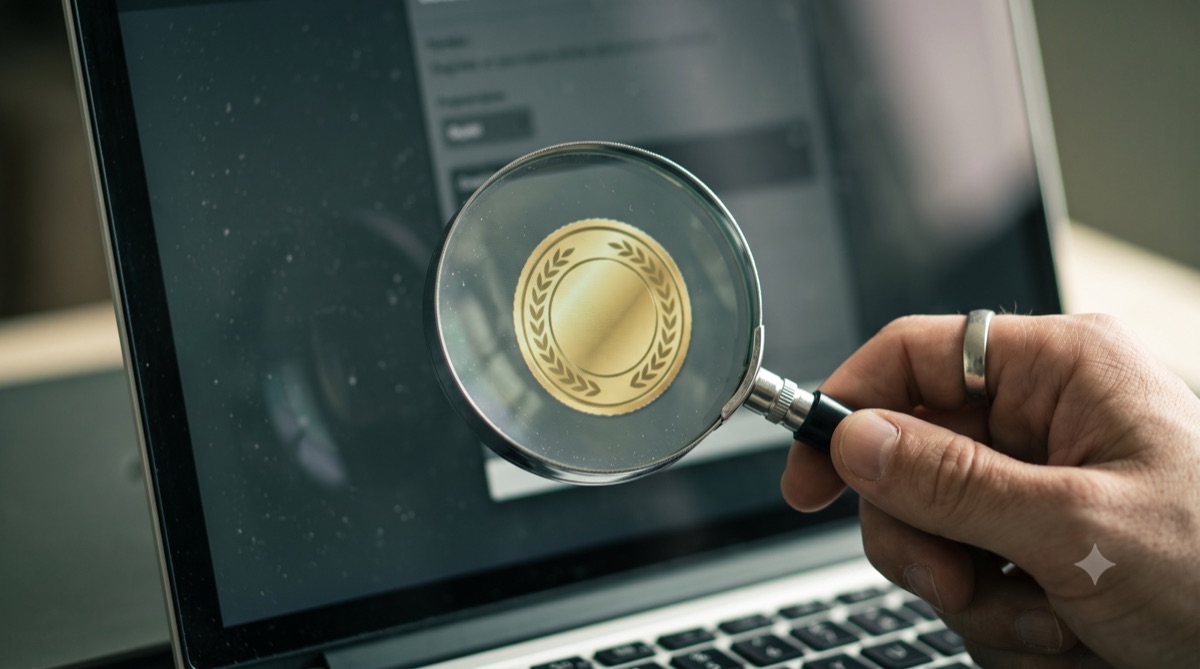
A trust seal in a shop is at first just a graphic. Whether a review stands behind it is shown by the seal provider’s directory: open it yourself and look the shop up there. Clicking the seal in the shop is at most an extra, because the shop sets the link itself. The help pages of Trusted Shops, a German seal provider, describe (in the version of August 2026) an extended seal with a personal authenticity code. The EHI Retail Institute keeps a public list of shops that display its seal without entitlement.
How to tell a genuine seal from an image
Behind a genuine seal there is a certificate with the provider, behind an image there is nothing. The most reliable place to check this is the provider’s directory, which you open yourself.The consumer advice centres (Verbraucherzentrale) and the German Federal Office for Information Security (BSI) additionally describe clicking the seal. According to the Verbraucherzentrale (as of 12 November 2025), you must be taken to the website of the seal operator, where the valid certificate is displayed.The certificate must name the shop from which it was linked. The Verbraucherzentrale continues (quotations from German sources in this article are our translation): “If the link only leads to some arbitrary page, or if you cannot click the seal at all, it is likely to be a forgery.”
The BSI lists the clickable seal as one of seven features: on clicking, further information about shop and order process appears, whereas the seal logos of fake shops are often not clickable or invented. The German police crime prevention service (ProPK) advises: “Be sceptical if a shop displays trust seals but does not link to the issuers.” What a trust seal is meant to do is explained in the glossary.
How to check Trusted Shops, EHI and the Austrian trustmark
Each provider has its own checking route. The details come from the providers’ own pages, retrieved on 3 October 2026.
- Trusted Shops. The provider keeps a shop search listing all currently certified shops. Look the shop up there. According to the provider, the seal is always clickable and leads to the shop’s certificate on the Trusted Shops site. In the certificate the status must be marked green and read “gültig” (valid). If it reads “nicht zertifiziert” (not certified), the shop currently does not meet the criteria, according to Trusted Shops.
- Trusted Shops with a personal code. The provider’s help pages describe an extended seal with a login. You set a personal code once, made up of your first name, a date and a colour. When you log in to a shop through the seal, it is shown to you. According to Trusted Shops, a faked shop cannot display it. This route requires an account with the provider.
- EHI Geprüfter Online-Shop. Look the shop up in the EHI shop list, which takes you to the certificate. According to EHI, clicking the seal leads there as well. EHI writes: “Only with a certificate is a seal valid and genuine.” According to EHI, the address of every genuine certificate begins with the same certificate address of the institute. So read the address bar of the certificate page. According to EHI, every shop is reviewed again each year.
- Austrian E-Commerce Trustmark. According to the provider, certified sites are reviewed annually and kept in a directory. Look the shop up there.
An overview of the seals with their checking routes is on the page trust seals.
Why the click alone is not enough
The seal link sits in the shop and leads wherever the operator points it. The police internet crime guide writes: “Seal providers’ pages that allowed a cross-check have even been faked already. For this reason the seal link on the shop page should not be followed.”It advises checking whether the shop is listed in the seal provider’s directory and paying attention to the spelling, since even a hyphen can make the difference. So open the seal provider’s site yourself, via a search engine or a bookmark.How whole shops are copied along with texts and images is described in the article Fake shops from a kit.
A seal that cannot be clicked may also be a technical fault. Trusted Shops names two possible reasons: a short-term technical fault or misuse. Looking the shop up in the directory settles both cases.
Discontinued, invented and confused seals
Invented and discontinued seals demonstrate no current review, and review seals show collected customer opinions.
- Invented seals. The Verbraucherzentrale writes: “Some retailers even invent their own seals with no added value behind them.” If it is not clear who awards a seal and what it stands for, it gives you nothing when buying.
- Discontinued seals. According to the German Wikipedia, the s@fer-shopping seal of TÜV Süd existed from 2001 to 2021. The TÜV Süd page on it could not be retrieved on 3 October 2026, so we rely on this secondary source here. A shop that still shows the logo does not demonstrate a current review with it.
- Review seals. Logos of review platforms show collected customer reviews. We distinguish them from certification seals, where the provider itself reviews the shop. How to read reviews is covered in the article Checking shop experiences and reviews.
The BSI points out that trust seals have different review methods and requirements, and advises checking which minimum requirements a seal confirms. According to the Verbraucherzentrale there is no uniform trust seal for online retailers. Both refer to the criteria of Initiative D21, a German public-private network.
What seal providers and the law do about misuse
The providers act against misuse. EHI keeps a public list of shops that use its seal unlawfully. On 3 October 2026 it contained 18 addresses. EHI writes that the operators are regularly based outside Germany and also outside the EU, so that immediate removal of the seal is as a rule not possible. By its own account, EHI also reports such shops to the Wettbewerbszentrale, a German association that pursues unfair competition.
Matching the 18 addresses against the 200 most recently checked entries of our fake shop list on the same day produced no hit. With a sample this small that was to be expected. 200 entries say nothing about our data as a whole.
Under no. 2 of the annex to Section 3 (3) UWG, “the use of quality marks, quality labels or the like without the required authorisation” is always prohibited towards consumers. You can report a suspicion to the provider. Trusted Shops accepts the link to the shop by email. EHI has a report form for shops that show the seal without a certificate link and do not appear in the list of seal holders.
What our shop check examines for seals
The shop check looks for seals on the page and checks their connection to the provider. In detail:
- Detection. It detects seals from embedded components, links, images and text. These include Trusted Shops, EHI Geprüfter Online-Shop, the Austrian E-Commerce Trustmark, Swiss Online Garantie, the Händlerbund buyer seal and the discontinued s@fer-shopping.
- Connection to the provider. For a certification seal it checks whether it leads to the provider.
- Query with Trusted Shops. For Trusted Shops it additionally queries the provider’s public shop search.
Checking in four steps
- Open the provider’s directory yourself.
Open the seal provider’s site via a bookmark or a search engine and look the shop up in the shop search or shop list. Pay attention to the spelling of the address. If you do not find it there, do not buy on the strength of the seal.
- Compare names and status.
The entry or certificate should name the shop’s address and the same company name as the legal notice. Look at the status: valid, expired or not certified.
- Use the click only as an extra.
If you click the seal in the shop, read the address bar. If only the shop’s home page opens, or a page without a certificate, that is a warning sign. If you appear to land on the provider’s site, that proves nothing, because the shop set the link itself.
- Report a suspicion.
Report the shop to the seal provider and send us the address via Report a shop, and we will check it for the list.
A seal does not replace the other checks
The BSI writes that the providers review only shops and order processes, and that a seal does not protect against phishing, for example. The Verbraucherzentrale states that a shop without a trust seal is not to be rated as dubious from the outset.So also look at the legal notice, the domain age and the payment methods. The features in context are described in the article Checking an online shop, and on paying by bank transfer see Advance payment in online shops.Further warning signs are on the page Spotting a fake shop.